
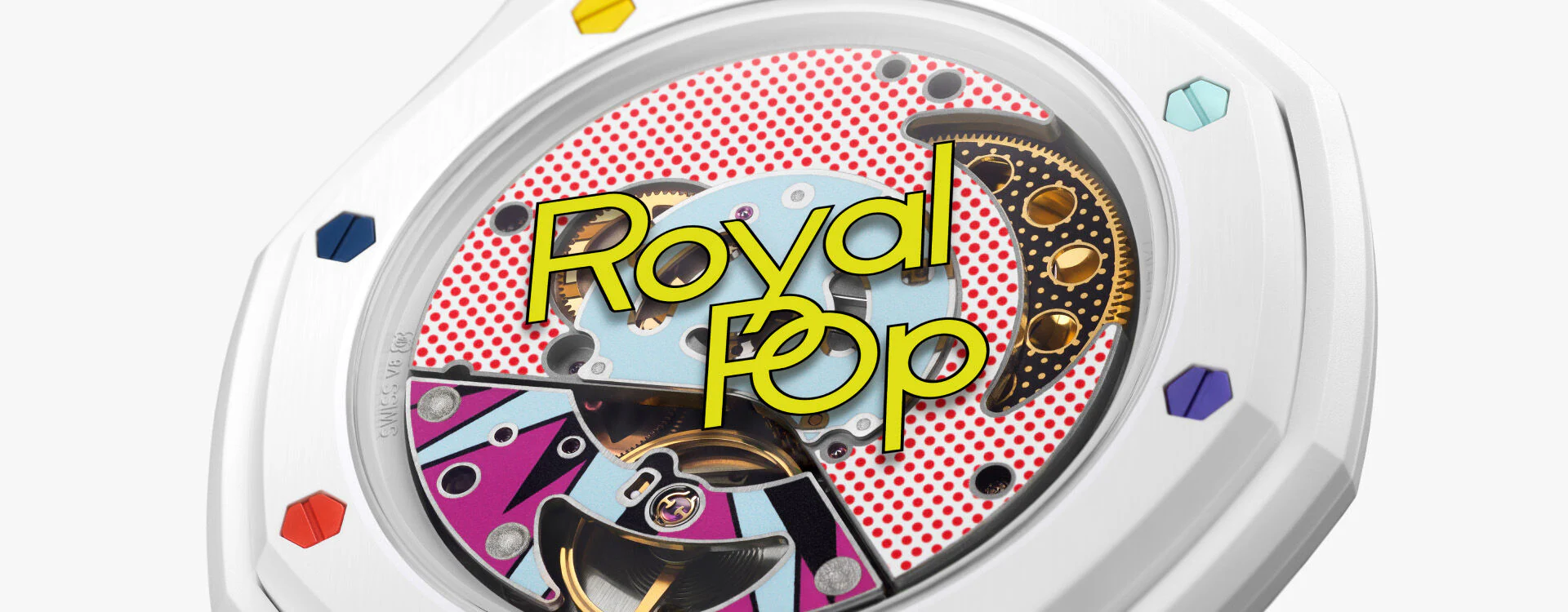
What is with this collaboration between Audemars Piguet (AP) x Swatch. More there than you might think, even if you’re not into wristwatches.

As you may have seen, not just in the horology press, reports about wristwatches suddenly shifted into high gear and entered the regular news cycle. You know the saying: if it bleeds, it leads. So, when people started scuffling outside boutiques as in Milano recently, to buy an Audemars Piguet x Swatch, generalist journalists took notice. Because I write a fair amount about watches, a friend asked me, essentially: “What’s up?”
The answer is: quite a lot, on several levels. If you are not into watches, though, here is a short briefing.
Let us first render unto Caesar: collaboration among watchmakers, and with other creative figures, is nothing new. Increasingly, brands have embraced it as a way to refresh identities threatened by a certain monocultural drift. In other words, if you do not cross-pollinate, you stagnate (© Marton Radkai).
Take the little brand Louis Erard, which, for years now, has partnered with the likes of Alain Silberstein, Vianney Halter, and Konstantin Chaykin.  Ever the iconoclast, Halter has also linked up with Behrens, a Chinese brand to produce the KWH (which means kilowatt/hour and was inspired by a piece of electrical equipment).
 More recently, H. Moser & Cie playfully “went slumming” (forgive the expression) with Studio Underd0g, producing a pair of watches in mango and watermelon colors that almost make your mouth water.
Some collaborations reach beyond watchmaking. Remember Reebok’s Pump sneaker from around 1990? This year, H. Moser & Cie, with characteristic humor, released its own Pump, complete with a bright orange pusher acting as a secondary winder on its Endeavour line. In a similarly tongue in cheek spirit, Yvan Arpa of ArtyA once collaborated with guitarist John McLaughlin on a Son of Sound Guitar watch.
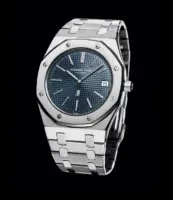
For the broader public, many of these names mean little. That is where the AP x Swatch comes in. Both brands are widely recognized, and the contrast could hardly be sharper. Audemars Piguet sits near the summit of watchmaking, alongside Patek Philippe and Rolex. Its brand identity is closely tied to the Royal Oak, Gérald Genta’s 1972 design, which survives as a genuine – if slightly weary – icon to this day.
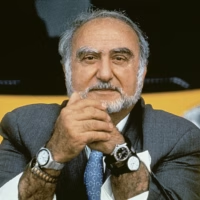
By contrast, Swatch, launched by Lebanese- born entrepreneur Nicolas Hayek (1928-2010), burst onto the scene in 1983 with a very different proposition. Switzerland was emerging from the Quartz Crisis, which had battered the industry throughout the 1970s. Swatch offered colorful, crazy watches with translucent plastic cases running on quartz movements. Nicolas Hayek had simply unleashed the full pop-design potential of the quartz watch as a “second watch,” one that is primarily fun.
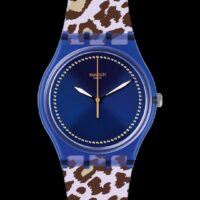
Now Swatch has done it again, this time persuading Audemars Piguet into what purists may s
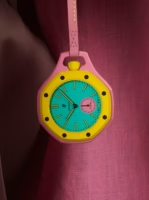
ee as a morganatic marriage. The hype was preprogrammed of course. Advocates of orologeria seria might recoil at the idea of the Royal Oak rendered in plastic, while others find precisely that irreverence appealing, especially since it shows up as a kitsch object at the end of a plastic fob.
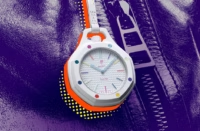

Are you a customer?
Whatever one thinks of the AP x Swatch, the marketing acumen behind it is undeniable. There are many reasons customers might want one. Nostalgia for the 1980s and 1990s is one. Another is the appeal of owning a playful take on a high horology icon. Then there is the speculative hope that supply will tighten while demand persists for these relatively accessible, around 400 euros, pieces. Yet neither brand has framed this as a limited edition.
For the industry, the attention is welcome. Jean Claude Biver who turned Hublot into a $1-billion enterprise, distilled his approach into a single imperative for me: “Be first in the news.” As communication theory reminds us, there is effectively no such thing as negative publicity… as long as it is not overwhelming. Entry level products can serve as gateways, expanding the audience and potentially lifting the entire sector. That, at least, is what smaller brands are no doubt hoping.
History lesson
In August 1971, faced with economic strains due to the Vietnam War, Nixon abandoned the Bretton Woods system of fixed exchange rates pegged to gold and let the dollar “float.” It promptly dropped, and with it a number of other currencies. In 1973, Switzerland decided to let the franc float as well. But as a perceived safe haven in unstable times, it surged. Swiss exports, including watches, became extremely expensive. Swiss industries suffered, and GDP dropped drastically. And hundreds of watch enterprises, either small brands or suppliers were forced to close. The trauma is still palpable.
In this context, the recent public disagreement between Swatch Group CEO Nick Hayek and SNB chairman Martin Schlegel is worthy of note given this backdrop. The Group saw a sharp decline of around 6% in revenues las year. Hayek argued that the strong franc poses a greater threat than US tariffs and criticized the SNB for inaction following a non-binding agreement in late 2025 aimed at stabilizing the currency. The SNB had guaranteed a fixed exchange rate (about €1,20 / $1,01 to the franc) until January 2015. The franc today is worth €1,10 and $1,28.


Hayek, son of Nicolas Hayek, is clearly seeing uncomfortable parallels with the past. The current oil crisis is also reinforcing that sense of déjà vu, even though many governments seem to prefer whistling past the graveyard… So, in its own way, the AP x Swatch release and the hype surrounding it also seems familiar. By the same token, lest we forget, the company that sold bright plastic watches in 1983 now presides over a portfolio that includes Blancpain, Breguet, Omega, and Glashütte Original. But that is another story.