
This truism hit home recently when I learned of the death of Jean-Marie Schaller, founder and leader of Les Ateliers Louis Moinet. He may have been unknown outside the community of ecstatic watch enthusiasts, especially collectors with a taste for the higher end. So whether you knew him, knew of him, or not, allow me to take three minutes of your day to share my goodbye, and perhaps enrich your knowledge along the way.

The heartfelt obituaries published by Les Ateliers Louis Moinet and scattered across social media say much about his creativity, his character, his personality. They speak of his company, founded in 2004, of his close-knit family, of his remarkably bold mind, and of his attachment to a period in Western history when art and science met and blended in harmony. That would be around the time Louis Moinet himself was active, a man as comfortable with the easel as with the telescope and the watchmaker’s tools. Anyone who has seen the Louis Moinet headquarters in an ancient house in Saint-Blaise will understand… Jean-Marie Schaller was all meteorites and late Rococo or Empire clocks.
Over the past six years, he shared his work with his son Nathanaël, as if he sensed—or perhaps knew—that his own clock’s power reserve was running low. Whatever ailed him, he did not say. But many noticed his pallor more than a year ago at Watches & Wonders. He wore his usual “trade fair vest,” a decorated frock coat that made him look like a late-18th-century nobleman. He was busy. We shook hands briefly; he smiled brightly, waved, and quickly returned to explaining something to a visitor.
The first time I met Jean-Marie Schaller was also at a trade fair—Baselworld 2013. About a year earlier, by a stroke of extraordinary luck, he had acquired the compteur de tierce, the stopwatch Louis Moinet had created to enable more precise astronomical calculations (more about this here, by my colleague Joël Grandjean). He was visibly excited as he presented it in a small booth near Hall 5, if memory serves. I still have the thumb drive with the Louis Moinet models from that year…
And so, every year, we met. Each encounter was thrilling, because he, or someone from his team, always had something extraordinary to show: watches with wild double tourbillons, mysterious Maya calendars, meteorites of every kind. Once, I ran into him in the street near the Beau-Rivage in Geneva. He carried a large, rather flimsy box. Smiling broadly, he opened it with care. I expected a watch. It was filled with gaudy doughnuts. “Pour les enfants,” he said, referring, I assume, to his team


.
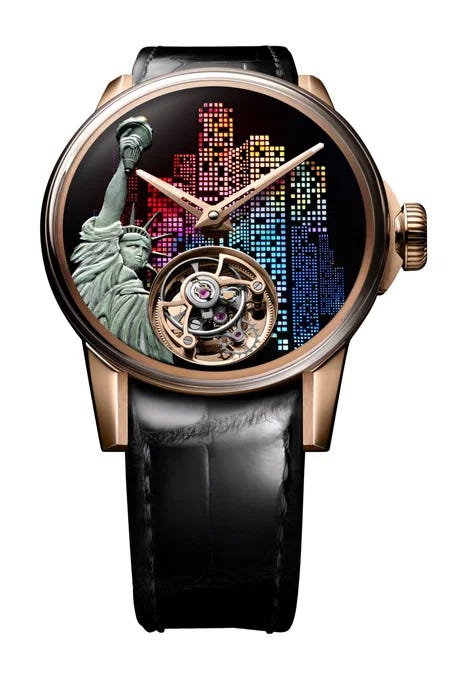
He was not a watchmaker. But then neither Verdi, Puccini, nor even Wagner played every instrument they composed for. He seemed to “see something” and then bring together the talent to make it real. Louis Moinet timepieces boldly told stories—from the world around us to the far reaches of the cosmos. One year, he introduced a curious piece featuring an oil well in motion; the next, a gasometer whose pressure valve cleverly indicated the power reserve. The Astronef Techno featured a dial made from a silicon microchip wafer. The names said it all: Cosmopolis, Jules Verne, Ultravox, the puzzle watches …

We may celebrate the man, but it is his bubbling imagination that has left a lasting mark on the industry that defines the region he came from—the Jura Mountains.
To close: last year, Louis Moinet released unusually classic, restrained timepieces—rare within an otherwise exuberant portfolio. The 1816 (the year Louis Moinet completed his compteur de tierces), and the 1806, marking the year Napoléon I acquired a Louis Moinet clock. Was Louis Moinet himself calling?


And while we will miss him, it is comforting to imagine a place beyond time, where old friends and kindred spirits gather—and congratulate one another on a job well done.
And I had wanted to interview him about one of his lesser-known projects. Now he is no longer here to tell me about it. A reminder that, damn it all, watches are not only beautiful objects that tell the time, but also that we have less and less of it. So, carpe diem… and goodbye, Jean-Marie.